

Picture a homeowner standing at the end of their path on a dreich November afternoon, holding a colour swatch against the brickwork and squinting. The shade that looked perfect in the brochure suddenly looks flat, or too bright, or nothing like the photo. Choosing between front door colours is one of the few decisions on a house that everyone walking past will see, so it’s worth getting right. Here’s how we’d approach it, the colour directions we expect to see more of in 2027, and the practical checks that stop a good choice turning into an expensive one.
Start with the house, not the swatch
The best door colour is the one that suits the building it’s going on. Before looking at any chart, look at what won’t change: the brick or stone, the render, the roof tiles, the window frames and the neighbours’ doors either side.
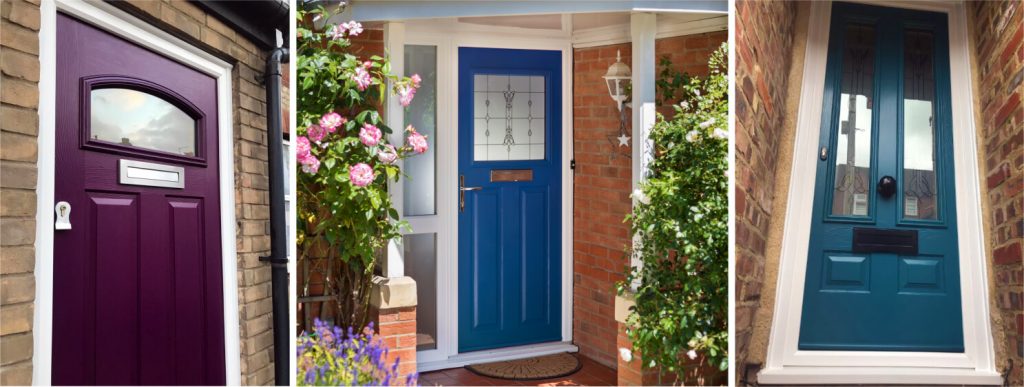
Red sandstone and warm orange brick are kinder to deep greens, navy and black than to bright reds, which can fight with them. Grey or white render gives you far more freedom, and it’s where stronger colours like teal or aubergine really stand out. Blonde sandstone, common across the Central Belt and the east, sits well with soft greys, sage and duck egg shades. If the windows are staying white, the door can carry the colour on its own. If the windows are being replaced too, you can plan the two together.
Front door colours to watch for 2027
Trends in front doors move slowly. A door is expected to last for many years, so people lean towards colours they won’t tire of. That said, a few directions look set to keep growing:
- Greens, from sage to deep forest. Green has moved from a “heritage” choice to an everyday one. Lighter sage greens suit modern estates, while darker greens look at home on stone villas and terraces.
- Softer greys. Dark anthracite grey has been the default modern choice for years. It isn’t going anywhere, but lighter, warmer greys are now being chosen alongside it, especially where the windows stay white.
- Rich, deep blues and teals. Navy and peacock-style teals give a classic look with more personality than black.
- Muted pastels. Duck egg and other chalky, matt-looking shades work well on cottages and smaller homes where a dark door can feel heavy.
- Woodgrain finishes. Oak and rosewood effects remain popular with owners who want the look of timber without the upkeep, particularly on traditional properties.
Black and white haven’t gone away either. A black door with silver-toned hardware is still one of the safest choices on almost any house.

A quick guide by house style
There are no fixed rules, but these pairings are a sensible starting point:
| House type | Colours that usually work | Worth a thought |
|---|---|---|
| Red sandstone villa or terrace | Deep green, navy, black, woodgrain | Bright reds can clash with the stone |
| Blonde sandstone cottage | Sage, duck egg, soft grey | Very dark doors can look heavy on small frontages |
| Modern new-build, brick | Anthracite grey, black, deep blue | Check estate or factor rules before ordering |
| Rendered bungalow or semi | Teal, aubergine, green, blue | A strong colour is a chance to give the house character |
| Older home with white windows staying | Almost anything, chosen to suit the stone or brick | Pick hardware that ties in with existing fittings |
If the property is listed or in a conservation area, speak to your local council’s planning department before choosing a colour or style. Some areas have guidance on door colours and designs, and it is much easier to check first than to change a door later.
Why the finish matters as much as the shade
A colour only looks good for as long as it lasts. Front doors face Scottish weather head-on, so how the colour is applied matters as much as which colour you pick.
On our Palladio composite doors, the colour is a wood foil applied across both the door leaf and the outer frame. Many composite doors are coloured and then set into a white uPVC frame, leaving a white border around the door, and some are spray painted to hide it. A family front door can be opened 25 to 30 times a day, and spray paint doesn’t always stand up to that. Our approach gives an even, colourfast, hard-wearing finish across the whole door set, and the doors are salt-spray tested, which matters on the coast.
Our uPVC doors come in white, rosewood and cherry as standard, including rosewood or cherry outside with white inside. A wider range of almost 15 colour combinations is available on special order, in quantities as low as two doors, which is useful for landlords and small developments. Trade windows and doors from Scotia are guaranteed for ten years against warping, cracking and discolouration. If you’re still weighing up the two door types, our honest comparison of composite and uPVC doors sets out the differences.
Matching windows, hardware and glass
A front door rarely sits alone. If you’re replacing windows at the same time, our uPVC windows are available with special woodgrain foils or spray-painted RAL finishes, so a grey door can sit with grey frames, or a white house can keep white windows and a coloured door. Both approaches work. What usually looks wrong is two greys or two greens that are almost, but not quite, the same.
Hardware is the other half of the look. Our composite range has five hardware finishes, and the choice changes the feel of the door. A cool metallic finish looks crisp on greys and blacks, while a warmer tone can lift greens, navy and woodgrain, so ask to see the finishes against your chosen colour. Glass matters too. A decorative panel adds a traditional touch, while slim vertical glazing suits a modern door.
Whatever the colour, security is the same. Our composite doors can meet PAS 24:2016 and Secured by Design, and our replacement domestic doors are BFRC Band A as standard. You can see our certificates on the accreditations page.
Five checks before you order
- Look at the colour outside, in daylight. Hold the sample against the wall on a grey day as well as a sunny one. Scottish light is often flat and can make colours look darker than expected.
- Decide on the inside face. Ask what inside finish is available on your chosen door, and whether you want colour on both sides or white inside to suit your hallway.
- Check any rules. Listed buildings, conservation areas, factors and some new-build estates have restrictions. Check before you order.
- Choose hardware with the colour. Pick the handle, letterplate and knocker finish at the same time, not as an afterthought.
- Think about the next ten years. A bold colour is great if you love it. If you might sell soon, a classic shade has wider appeal.
Once the door is fitted, a little care keeps the finish looking new. Our winter maintenance checklist and aftercare guides explain how to clean and look after your doors.
See the colours for yourself
We’ve been making windows and doors in Ayrshire since 1983, and our range goes well beyond white. Have a look at our colour profile options or download our brochure to see the styles side by side. Installers and joiners can order through Scotia Trade, and homeowners can get in touch with our team to talk through colours, styles and security options for their new front door.
Comments are closed.