
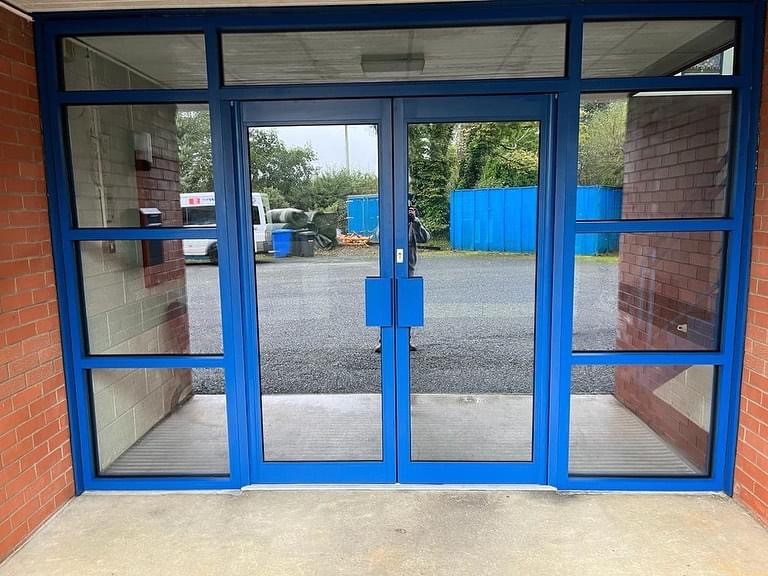
Stand at the front door of a primary school at 8.45 on a wet Monday and count. Parents, pupils, buggies, a delivery driver, the janitor with a trolley. A busy commercial entrance can open and close hundreds of times before lunch, in wind and rain, and it still has to lock tight at night, keep the heat in and let a wheelchair user through without a fight.
That is why most schools, health centres, shops and offices in Scotland end up with aluminium commercial entrance doors, and why the details of the specification matter more than the colour. This guide walks through the decisions a specifier or contractor has to make, in the order we usually work through them with clients at Scotia Aluminium.
Why the thermal break comes first
Aluminium is strong, stiff and takes a powder-coated finish well, which is exactly what a high-traffic door needs. It also conducts heat very well, which is exactly what an entrance in a Scottish winter does not need. An old solid aluminium shopfront door is cold to the touch on the inside, streams with condensation and loses heat through the frame all day.
A thermally broken door solves this by splitting each profile into an inner and outer section, joined by an insulating polyamide bar. The structure stays aluminium, but the heat path through the frame is interrupted. In practice that gives:
- Lower U-values for the door and framing, which helps the whole building meet the energy standards in Section 6
- Warmer internal surfaces, so less condensation around the frame in reception areas
- A more comfortable space just inside the door, where staff often sit
Our thermal commercial door and framing system is made at our Kilmarnock factory for exactly this kind of opening. It is designed for high-traffic locations and suits commercial, health, education and retail buildings.
Single or double, single or dual swing
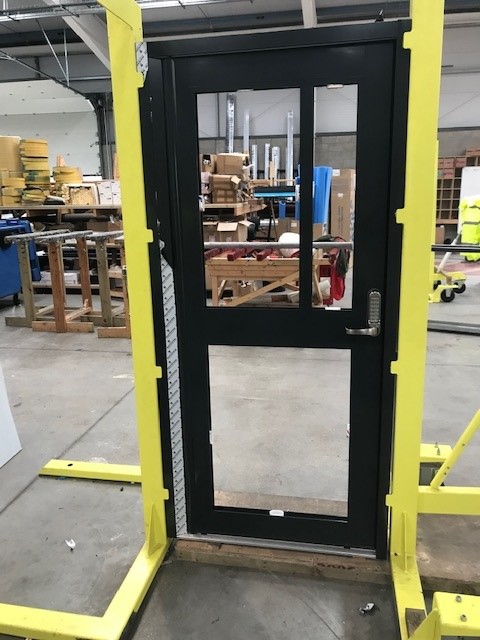
The next decision is how the door opens. It depends on how many people use it, what passes through it and whether it is also an escape route. Our commercial system is available as single or double doors, in single or dual swing.
| Configuration | Typical use | Points to check |
|---|---|---|
| Single door, single swing | Staff entrances, side doors, small shops and offices | Clear width for wheelchairs, door closer force |
| Double doors, single swing | Main entrances to schools, surgeries and offices; deliveries and equipment | Whether one leaf alone gives enough clear width day to day |
| Dual swing (double action) | Busy through-routes where people move both ways | Vision panels so people can see who is coming the other way |
Size matters too. The system takes sash heights up to 3000mm and sash weights up to 100kg, so tall entrances in a double-height reception or under a canopy are usually possible without resorting to a heavier, slower door.
Access, thresholds and the Scottish standards
For non-domestic buildings, standard 4.1 of the Scottish technical handbook expects an accessible route to the principal entrance, and to other entrances used by particular groups such as staff or visitors, with no steps, kerbs or similar barriers. The door is part of that route, so the threshold detail needs to be agreed early, not on the day of fitting.
A low threshold gives easy access for wheelchairs, buggies and trolleys, but it has to be detailed with the drainage and the external levels so water stays out on an exposed site. Our aluminium entrance doors are weather tested to BS 6375 Parts 1 and 2 and can be made with a fully rebated threshold or a low threshold, so the right option can be chosen for each opening.
Locks, panic gear and anti-finger trap
Hardware is where a commercial door earns its keep, and where most call-backs start. Work through these with the end user, the fire strategy and the insurer in mind:
- Locking. Single point locks suit internal lobbies and low-risk doors. Multipoint locks give better security and help the leaf stay tight to the seals on a big door.
- Escape. Where the door is on an escape route used by the public, panic hardware is usually specified so it opens with a push in an emergency. Panic gear is an option on our system.
- Finger protection. Anti-finger trap protection on the hinge side is well worth it for schools, nurseries and care settings, and is available as an option.
- Security. For ground-floor entrances that need tested security, PAS 24 security tested ironmongery options are available. Our guide to PAS 24 and Secured by Design explains what the testing covers.
- Access control. If keypads, card readers or electric strikes are planned, tell us before manufacture so they can be planned into the order.
Glazing and finish
Doors and frames on our commercial system take double glazed units from 28mm to 44mm, so the glass specification can be chosen to suit the opening and the site.
The aluminium is powder coated in a single or dual RAL finish. Dual colour is popular on schools and health buildings: a brand or wayfinding colour outside, with a neutral white or grey inside to match the internal joinery.

Think about the whole entrance, not just the door
On many projects the entrance door sits in a glazed screen, a run of shopfront or a full curtain walling facade. Getting the door, screen and surrounding aluminium windows from one manufacturer keeps sightlines, colours and thermal performance consistent, and gives the main contractor one point of contact for the whole package. Our post on curtain walling aluminium solutions covers the facade side in more detail.
Through Scotia Commercial, our technical team can advise before tender packages go out, and we can deliver to sites across Scotland on a call-off basis. We offer supply only, or a full site survey and installation service, with CSCS-carded installers and site engineers who commission the doors and support the building after handover. Our accreditations include ISO 9001, ISO 14001 and CHAS.
Get a commercial door specification checked
If you have a school, surgery, shop or office entrance on the drawing board, send us the elevations and door schedule early. Contact the Scotia Aluminium team to talk through configurations, hardware and thresholds, or download our brochure to see the full aluminium range.
Comments are closed.